Documentation Index
Fetch the complete documentation index at: https://budecosystem-b7b14df4.mintlify.app/llms.txt
Use this file to discover all available pages before exploring further.
System Architecture
Bud Runtime is built on a microservices architecture designed for scalability, reliability, and performance.
Core Components
Component Details
API Gateway
The API Gateway serves as the single entry point for all client requests:
- Load Balancing: Distributes requests across model servers
- Authentication: Validates API keys and JWT tokens
- Rate Limiting: Enforces usage quotas
- Request Routing: Routes to appropriate model servers
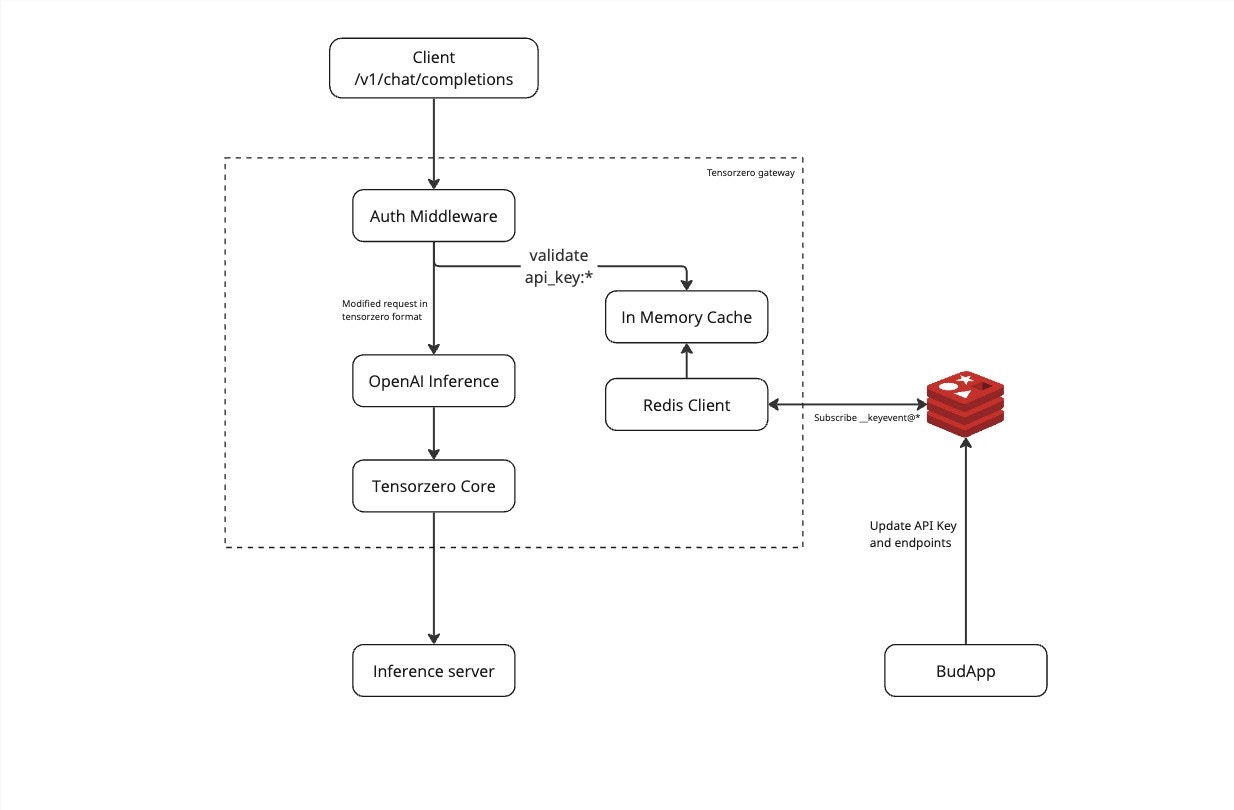
Model Servers
Model servers handle the actual inference workloads:
- Model Loading: Efficient loading and caching of models
- Batch Processing: Groups requests for better throughput
- GPU Management: Optimal GPU memory utilization
- Health Monitoring: Regular health checks and auto-recovery
Storage Layer
Storage Components:
  Model Repository:
    - Type: Object Storage (S3-compatible)
    - Purpose: Central model storage
    - Features: Versioning, replication

  Cache Layer:
    - Type: Distributed cache (Redis)
    - Purpose: Fast model weight access
    - Features: LRU eviction, persistence

  Metadata Store:
    - Type: PostgreSQL
    - Purpose: Model metadata, configurations
    - Features: ACID compliance, replication
Request Flow
Text Generation Request
- Client Request: Client sends request to API Gateway
- Authentication: Gateway validates credentials
- Rate Limiting: Checks against usage quotas
- Routing: Determines optimal model server
- Model Loading: Server loads model if not cached
- Inference: Processes request on GPU
- Response: Returns generated text to client
Client->Gateway: POST /v1/completions
Gateway->Auth: Validate token
Auth->Gateway: Token valid
Gateway->Router: Route request
Router->ModelServer: Forward request
ModelServer->GPU: Run inference
GPU->ModelServer: Return output
ModelServer->Gateway: Send response
Gateway->Client: Return completion
Image Generation Request
Similar flow with additional steps:
- Preprocessing: Image prompt processing
- Model Selection: Choose appropriate image model
- Generation: Multi-step diffusion process
- Post-processing: Image encoding and storage
- URL Generation: Create accessible image URL
Scaling Architecture
Horizontal Scaling
Scaling Strategy:
  Model Servers:
    - Auto-scaling based on GPU utilization
    - Min replicas: 1
    - Max replicas: 100
    - Target GPU utilization: 70%

  API Gateway:
    - CPU-based auto-scaling
    - Min replicas: 2
    - Max replicas: 20
    - Target CPU: 60%
Vertical Scaling
GPU Tiers:
  Small Models:
    - GPU: NVIDIA T4
    - Memory: 16GB
    - Models: 7B parameters

  Medium Models:
    - GPU: NVIDIA A10
    - Memory: 24GB
    - Models: 13B parameters

  Large Models:
    - GPU: NVIDIA A100
    - Memory: 80GB
    - Models: 70B+ parameters
High Availability
Redundancy
- Multi-zone deployment: Spread across availability zones
- Model replication: Multiple copies of each model
- Database replication: Primary-replica setup
- Gateway redundancy: Multiple gateway instances
Failover Strategy
Failover Configuration:
  Health Checks:
    - Interval: 10s
    - Timeout: 5s
    - Threshold: 3 failures

  Recovery:
    - Automatic pod restart
    - Node evacuation on failure
    - Cross-zone failover
    - Circuit breaker pattern
Caching Strategy
class ModelCache:
    """Multi-level caching for model weights."""

    def __init__(self):
        self.l1_cache = {}  # In-memory cache
        self.l2_cache = RedisCache()  # Distributed cache
        self.l3_cache = S3Storage()  # Persistent storage

    async def get_model(self, model_id: str) -> Model:
        # Try L1 cache first
        if model_id in self.l1_cache:
            return self.l1_cache[model_id]

        # Try L2 cache
        model = await self.l2_cache.get(model_id)
        if model:
            self.l1_cache[model_id] = model
            return model

        # Load from L3 storage
        model = await self.l3_cache.load(model_id)
        await self.l2_cache.set(model_id, model)
        self.l1_cache[model_id] = model
        return model
Batch Processing
type BatchProcessor struct {
    batchSize    int
    batchTimeout time.Duration
    queue        chan Request
    processor    ModelProcessor
}

func (b *BatchProcessor) Process() {
    batch := make([]Request, 0, b.batchSize)
    timer := time.NewTimer(b.batchTimeout)

    for {
        select {
        case req := <-b.queue:
            batch = append(batch, req)
            if len(batch) >= b.batchSize {
                b.processBatch(batch)
                batch = batch[:0]
                timer.Reset(b.batchTimeout)
            }
        case <-timer.C:
            if len(batch) > 0 {
                b.processBatch(batch)
                batch = batch[:0]
            }
            timer.Reset(b.batchTimeout)
        }
    }
}
Security Architecture
Network Security
Network Policies:
  Ingress:
    - Allow from Load Balancer only
    - TLS 1.3 minimum
    - Certificate pinning

  Egress:
    - Model repository access
    - Metrics endpoints
    - No external internet access

  Inter-service:
    - mTLS between services
    - Service mesh (Istio)
    - Network segmentation
Data Security
- Encryption at rest: All stored data encrypted
- Encryption in transit: TLS for all communications
- Key management: Integrated with KMS
- Access control: RBAC with fine-grained permissions
Monitoring Architecture
Metrics Collection
Metrics Stack:
  Collection:
    - Prometheus for metrics
    - OpenTelemetry for traces
    - Fluentd for logs

  Storage:
    - Thanos for long-term metrics
    - Elasticsearch for logs
    - Jaeger for traces

  Visualization:
    - Grafana dashboards
    - Custom monitoring UI
    - Alert manager
Key Metrics
# System Metrics
- GPU Utilization: gpu_utilization_percent
- Memory Usage: container_memory_usage_bytes
- Request Latency: http_request_duration_seconds
- Error Rate: http_requests_total{status=~"5.."}

# Business Metrics
- Tokens Generated: tokens_generated_total
- Model Usage: model_requests_total{model}
- User Activity: active_users_daily
- Cost per Request: request_cost_dollars
Development Architecture
CI/CD Pipeline
Pipeline Stages:
  Build:
    - Code compilation
    - Docker image creation
    - Security scanning

  Test:
    - Unit tests
    - Integration tests
    - Performance tests

  Deploy:
    - Staging deployment
    - Smoke tests
    - Production rollout
    - Health verification
Development Environment
Dev Setup:
  Local:
    - Kind/Minikube cluster
    - Mock GPU support
    - Local model cache

  Staging:
    - Full cluster replica
    - Subset of models
    - Performance testing

  Production:
    - Multi-region deployment
    - Full model catalog
    - High availability
